Proper roof ventilation is important for removing warm, moist or contaminated air from buildings and structures. Effective ventilation ensures continuous air circulation, where warm and moist air is extracted and fresh air is supplied.
Roof ventilation can be arranged in different ways. A distinction is made between mechanical (active) ventilation, natural (passive) ventilation and hybrid solutions in which both principles are combined. Natural ventilation uses the thermal rise of warm air (convection) or pressure differences, also known as draft.
Wind-driven ventilation is a natural form of roof ventilation that uses wind energy to extract air from a building. The rotating movement of a wind-driven ventilator creates negative pressure in the ventilation duct, allowing warm, moist or contaminated air to be continuously removed. This effect remains present even at lower wind speeds.
Because no motor or electrical connection is required, wind-driven ventilation is energy-efficient, low-maintenance and durable. The system is therefore particularly suitable for situations where ventilation is required but electricity is not available.
Within this principle, the Silairo wind-driven ventilator from Tilmar provides a technically optimized solution for roof ventilation. Thanks to its innovative design and well-balanced, extremely low-friction bearings, air extraction in ventilation ducts is improved.
The Silairo wind-driven ventilator is a natural roof ventilation solution applied to ventilation ducts for air extraction from buildings and structures. The ventilator uses wind to support air extraction without the use of electricity.
The Silairo has been developed as a technically optimized wind-driven ventilator in which both the external design and the internal airflow have been optimized for a high and stable extraction capacity. This optimization is reflected in the construction of the ventilator.
This ventilator was designed using extensive wind tunnel testing. During development, the shortcomings of many traditional metal wind-driven ventilators were analysed in order to achieve an optimal shape for maximum air extraction. The following distinguishing features are essential for optimal extraction performance:
The ventilator consists of three blade sections:
The internal airflow section is aerodynamically shaped to minimize resistance to the extracted air. This results in stable and effective air extraction while preventing backflow.
Unique technical characteristics of the Silairo wind-driven ventilator include:
The Silairo wind-driven ventilator is made from high-quality ABS plastic with stainless steel components. This material combination provides a lightweight and durable construction that is highly resistant to weather influences. As a result, the Silairo is suitable for long-term roof installation and requires minimal maintenance. The Silairo is designed for installation on ventilation ducts for air extraction from buildings or structures, supporting natural airflow to the outside.
Important note:
Other products must be used for flue gas discharge or the extraction of aggressive industrial vapours.
The Silairo wind-driven ventilator can be combined with additional Tilmar products. A plastic adapter is available specifically for the Silairo wind-driven ventilator. This adapter allows the Silairo ventilator with nominal size Ø125 mm to be easily connected to thick-walled and/or insulated roof outlets with outside diameters of Ø131 mm, Ø150 mm and Ø160 mm.
For installation of roof accessories on flat roofs, an aluminium mounting plate with a Ø125 mm connection is also available. This plate has a height of 24 cm and a base diameter of 39 cm. It allows the Silairo to be mounted securely and watertight on flat roof constructions.
In summary, the Silairo wind-driven ventilator provides a well-designed and technically optimized solution for natural roof ventilation. The ventilator clearly distinguishes itself within the wind-driven ventilation segment through the following advantages:
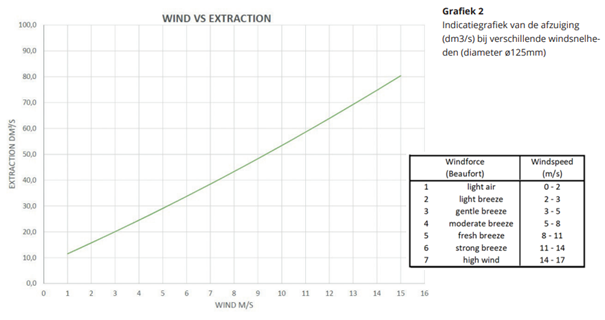
The excellent performance of the Silairo is illustrated in Graph 1. The grey area represents the operating range of an open pipe. It clearly shows that the angle of wind incidence can cause large variations in airflow at any wind speed. An open pipe is also highly sensitive to backflow. At favourable wind angles extraction occurs, but at unfavourable wind angles significant unwanted backflow can occur. The blue area represents the operating range of the Silairo. With the Silairo, backflow does not occur and the variation in air extraction at each wind speed is limited, resulting in a stable performance pattern. It is also clear that the Silairo provides a higher extraction capacity than an open pipe.
.png)




 Nederlands
  Deutsch
  Français