A properly functioning facade starts with correct execution of the masonry. Ventilation and drainage of cavity walls are necessary to remove vapour and moisture that have entered the cavity as a result of penetration or condensation. This is important for preserving the structural integrity of the building.
To ensure that cavity ventilation is applied correctly, clear installation guidelines have been established. These guidelines provide guidance in determining the number and positioning of ventilation openings in the masonry and form the basis for a durable facade construction.
Weep hole vents are used instead of open perpend joints to prevent the entry of pests and dirt and to provide a better facade appearance. Openings in facade masonry are necessary for ventilating and draining the cavity. For this reason, certain perpend joints are traditionally left open during construction.
These open perpend joints allow air circulation and moisture drainage but also have disadvantages in terms of protection and facade appearance. For this reason, cavity wall weep vents are increasingly used in modern construction practice, providing the same function within the framework of the installation guidelines.
For cavity wall ventilation, the brick industry provides the following masonry guidelines:
To ensure proper ventilation and drainage of the cavity, at all horizontal terminations of the masonry, such as below and above window frames, one perpend joint should be left open for every three to four stretchers. To ensure proper drainage of moisture that may accumulate behind the outer leaf, at the junction of the masonry and the foundation one perpend joint should be left open for every two stretchers.
These guidelines are taken from Information Sheet 45: Installation guidelines for clay brick masonry, published by the Royal Dutch Building Ceramics Association (KNB Keramiek, www.knb-keramiek.nl). The guidelines can also be found, with additional references to standards, in the publication "Design Guidelines – Brick in Exterior Facades" by KNB Keramiek.
Based on the ventilation opening area in mm², cavity ventilation is defined in three categories: non-ventilated cavity, weakly ventilated cavity and strongly ventilated cavity.
The masonry guidelines combined with BRL 2826 / NTA 8800 / NPR 2068 result in the following general recommendation table:
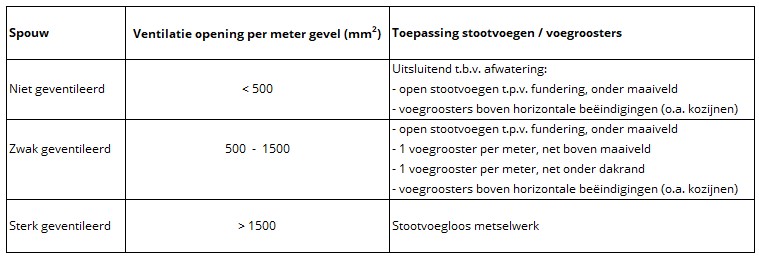
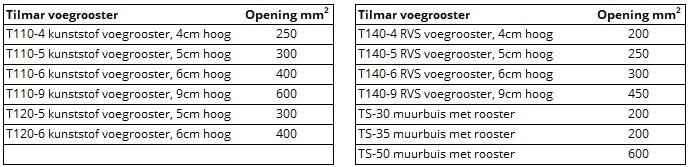
For quick calculations, the general table above can be used. For a weakly ventilated cavity, a practical rule of thumb is to use three weep vents or wall tubes per metre of facade. The ventilation opening area of weep vents and wall tubes varies by type and depends on their dimensions. The Tilmar range of weep vents and wall tubes provides ventilation openings ranging from 200 to 600 mm² per unit. For detailed calculations, the tables below can be used:




 Nederlands
  Deutsch
  Français